

The 2026 Shift in NFT Utility
The classification of Non-Fungible Tokens (NFTs) has undergone a structural redefinition in 2026. The sector has transitioned from a speculative asset class driven by collectible scarcity to a functional layer of decentralized infrastructure. Governance NFTs 2026 no longer serve primarily as status symbols or tradable derivatives; they now operate as cryptographic keys for decentralized decision-making, access control, and regulatory compliance.
This shift is evident in the divergence between general NFT trading volume and governance-specific activity. While broad market liquidity has contracted, on-chain voting participation and staking metrics for governance tokens have stabilized. The following chart illustrates this structural divergence, highlighting how utility-driven tokens have decoupled from the speculative cycles that characterized previous market cycles.
The legal and regulatory framework surrounding these assets has evolved in tandem. Governance NFTs are increasingly treated as functional instruments rather than pure property. This reclassification impacts how they are audited, taxed, and integrated into corporate governance structures. Projects that fail to demonstrate clear utility in voting, certification, or licensing are facing reduced relevance, as the market selectively favors infrastructure over collectibles.
Consequently, the value proposition of a governance NFT is now tied to its operational efficacy within a decentralized autonomous organization (DAO) or a regulated entity. The focus has moved from price appreciation to the tangible impact of token-based voting rights and access privileges. This maturation signals a move toward sustainable, utility-first governance models that prioritize long-term stability over short-term speculation.
On-chain voting mechanics
Governance NFTs in 2026 function as non-fungible credentials that grant specific voting rights within decentralized protocols. Unlike traditional token-based voting, where influence is proportional to the quantity of fungible tokens held, NFT governance ties authority to unique, verifiable on-chain assets. This structural shift addresses long-standing vulnerabilities in decentralized autonomous organizations (DAOs), particularly regarding identity verification and sybil resistance.
In a token-based system, voting power is easily concentrated through accumulation or aggregation, creating centralization risks that contradict the ethos of decentralization. NFT-based governance introduces a distinct layer of complexity by requiring the holder to possess a specific, non-transferable (or semi-transferable) digital identity. This mechanism ensures that each vote corresponds to a unique entity, significantly raising the cost for bad actors attempting to manipulate outcomes through multiple synthetic identities.
The Pera Wallet’s implementation on the Algorand blockchain illustrates this evolution. By treating governance participation as a distinct period-bound activity, the system allows for more nuanced control over voting power. Projects like Hone leverage this structure to direct liquidity and influence ecosystem development, demonstrating how NFTs can serve as functional infrastructure rather than mere collectibles. The transferability of rights in this model is often restricted or time-bound, ensuring that governance decisions reflect the intent of the current holder rather than a speculative investor.
| Feature | Token-Based Voting | NFT-Based Voting |
|---|---|---|
| Sybil Resistance | Low; vulnerable to wallet aggregation | High; unique on-chain identity required |
| Voting Power | Proportional to token quantity | Binary or tiered based on NFT traits |
| Transferability | High; rights move with tokens | Restricted; often bound to specific periods |
| Identity Verification | Pseudonymous | Pseudonymous but distinct per asset |
This approach aligns with regulatory expectations for clear accountability in digital governance. By linking voting rights to specific, auditable assets, protocols can provide transparent records of participation that are more resistant to manipulation than simple token balances. The focus remains on the integrity of the vote rather than the volume of capital deployed, marking a significant maturation of on-chain governance mechanisms.
Real-world DAO voting examples
The transition from speculative collectibles to functional governance infrastructure is evident in protocols that have integrated NFTs as primary voting credentials. In 2026, the distinction between ownership and authority is defined by on-chain verification rather than token balance alone. These implementations demonstrate how governance NFTs 2026 serve as the foundational layer for decentralized decision-making, ensuring that voting power aligns with long-term commitment rather than short-term market speculation.
Developer DAO: Legacy Access Integration
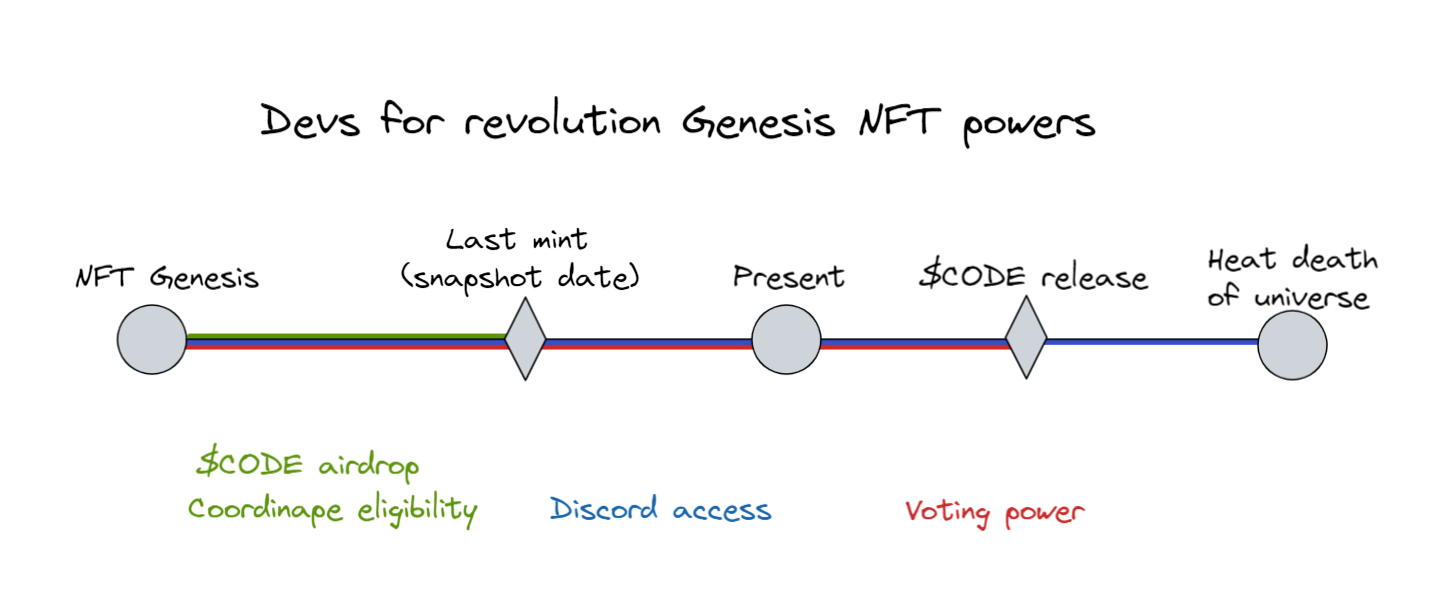
Developer DAO illustrates the structural shift from simple membership to complex governance rights. The protocol migrated its voting mechanism from traditional ERC-20 tokens to an NFT-based system, where the original "Devs for Revolution" NFTs were repurposed to grant access to the governance forum. This migration required precise smart contract logic to ensure that historical contributors retained their voting weight without diluting the authority of new participants. The forum interface, which manages these issuance topics, reflects a mature approach to community coordination where identity and voting power are inextricably linked.
Algorand: Periodic Governance Cycles
On the Algorand blockchain, governance NFTs operate within defined temporal cycles, creating a structured environment for protocol upgrades. Pera Wallet facilitates this process by issuing exclusive NFTs for each governance period, such as Period 6, which serve as proof of participation. These NFTs are not merely commemorative; they act as keys to voting on ecosystem proposals, including liquidity incentives and protocol improvements. This model ensures that governance activity is concentrated among active participants, reducing the risk of sybil attacks and ensuring that decisions reflect the will of engaged community members rather than passive holders.
Technical Analysis of Governance Activity
The efficacy of these governance structures can be monitored through on-chain metrics and market performance. While the primary focus is on voting outcomes, the underlying asset value often correlates with governance participation rates. The following chart provides a technical perspective on the broader market conditions that influence governance NFT liquidity and adoption.
Legal and regulatory considerations
The transition of governance NFTs from speculative collectibles to functional voting infrastructure has triggered significant scrutiny from regulatory bodies worldwide. In 2026, the primary legal challenge remains the classification of these digital assets. Regulators are increasingly evaluating whether a governance NFT constitutes a security, a utility token, or a form of digital property rights. This distinction is critical because it determines the compliance burden for issuers and the legal protections for holders.
In the United States, the Securities and Exchange Commission (SEC) continues to apply the Howey Test to determine if an NFT offers an "expectation of profits primarily from the efforts of others." If a governance NFT is deemed a security, its distribution and secondary trading must comply with federal securities laws, including registration requirements or valid exemptions. This regulatory uncertainty creates a high-stakes environment for organizations attempting to decentralize governance structures.
Note: The legal classification of governance NFTs as securities or utility tokens remains unresolved in many major jurisdictions. Organizations must conduct rigorous legal analysis to mitigate the risk of enforcement actions.
Internationally, the approach varies significantly. The European Union’s Markets in Crypto-Assets (MiCA) regulation provides a more structured framework for digital assets, though its specific application to NFTs with governance rights is still being interpreted. In contrast, some jurisdictions have yet to establish clear guidelines, leaving projects in a regulatory gray area. This fragmentation complicates the global deployment of decentralized autonomous organizations (DAOs) that rely on NFT-based voting.
Scholarly analysis suggests that governments may not initially recognize NFTs as credible tools for urban or institutional governance, preferring to integrate them cautiously within classical property regimes. As noted in recent legal research, the disruptive potential of NFTs is tempered by the need for legal clarity regarding ownership and voting rights. This hesitation slows the adoption of governance NFTs in traditional sectors such as real estate and public administration.
The risk of regulatory misclassification is not merely theoretical. Projects that fail to properly structure their governance NFTs face the possibility of being shut down or fined. As the market matures, we expect a consolidation of projects that prioritize legal compliance. The survivors will likely be those that can demonstrate clear utility and adherence to existing financial regulations, rather than those relying on speculative hype. This shift marks a transition from the chaotic boom years to a more regulated, institutional phase of the NFT ecosystem.
Market trends and investment outlook
The 2026 market for governance NFTs has shifted from speculative collectibility to functional infrastructure. Unlike the 2021 boom, which prioritized brand recognition and secondary trading volume, current demand centers on utility: access rights, certification, and voting power. Projects that fail to deliver tangible governance mechanisms are losing liquidity, while those integrated into legal or regulatory frameworks are gaining institutional interest.
This transition is evident in the performance of major collections. While general NFT market activity has contracted, governance-focused assets maintain relevance by serving as keys to exclusive ecosystems. For instance, Algorand-based governance NFTs by Pera are currently enhancing liquidity flows through structured voting periods, demonstrating how technical utility can sustain market value beyond mere ownership. Similarly, broader industry analysis confirms that NFTs are increasingly functioning as infrastructure for licensing and membership rather than digital art.
Investors must distinguish between speculative assets and functional tokens. The best-performing projects in 2026, such as CryptoPunks and Pudgy Penguins, derive value from deep liquidity and real-world utility, respectively. However, for governance-specific investments, the primary metric is the robustness of the underlying protocol and its alignment with regulatory standards. Static market data should be interpreted with caution; live provider-backed widgets are essential for assessing current liquidity and trading activity.
No comments yet. Be the first to share your thoughts!