

Why governance NFTs matter in 2026
The NFT market has completed its transition from speculative asset collection to utility-driven infrastructure. In 2026, the primary value driver for Decentralized Autonomous Organizations (DAOs) is no longer rarity or floor price, but verifiable accountability. Governance NFTs have emerged as the standard mechanism for linking digital ownership with real-world decision-making rights.
This shift reflects a broader maturation of the sector. As noted in recent market analysis, speculation-driven NFTs are fading because they lack intrinsic utility. Users and institutions now demand access, ownership rights, and identity verification embedded within these tokens. Governance NFTs satisfy this demand by serving as non-transferable or soulbound keys that grant voting power in DAO proposals.
The stakes for DAOs are higher than ever. Without on-chain voting mechanisms anchored by unique governance tokens, organizations struggle with low participation and opaque decision-making. By tying voting rights to specific NFT holdings, DAOs create a transparent audit trail. This accountability is no longer optional; it is the foundation of trust in decentralized governance.
The technology enabling this shift is mature. Smart contracts now allow for complex voting weights, quadratic voting, and delegation directly tied to NFT metadata. This ensures that governance power reflects the holder’s stake and commitment, reducing the impact of whale manipulation and sybil attacks.
As we look at the broader market, the distinction between financial assets and governance instruments is blurring. A governance NFT is not just a ticket to vote; it is a credential of membership. This evolution ensures that DAOs remain relevant and functional in an increasingly regulated and utility-focused digital economy.
How governance NFTs function as voting tickets
On-chain voting mechanics rely on a straightforward principle: the governance NFT is the ticket. Unlike traditional DAOs that might distribute ERC-20 tokens or rely on delegated voting power, governance NFTs tie voting rights to a specific, non-fungible identity. This design ensures that each vote is unique and tied to a verifiable on-chain asset, preventing the centralization of power that often occurs when large token holders dominate decision-making.
The immutability of the blockchain guarantees that once a vote is cast, it cannot be altered or erased. This creates a permanent record of community sentiment, which is essential for accountability. When a proposal passes, the smart contract executes the outcome automatically. There is no need for trusted intermediaries to count ballots or verify results. The code is the law, and the NFT is the key that unlocks the ability to participate in that law.
Transparency is further enhanced by the public nature of the ledger. Anyone can inspect the voting history of a specific NFT or aggregate the voting patterns of an entire DAO. This visibility allows members to hold leaders accountable and ensures that decisions reflect the will of the community rather than a hidden agenda. As the ecosystem matures, these mechanics are becoming the standard for robust, decentralized governance.
The correlation between active governance participation and the health of a DAO is often visible in market metrics. While token price does not dictate governance power, active engagement with governance NFTs can signal a healthy, committed community. Tools like the chart above help visualize broader market trends, but the true measure of a DAO’s strength lies in its on-chain activity and the clarity of its voting records.
Leading governance NFT ecosystems
The shift from speculative art to functional digital identity is most visible in the governance NFT sector. These ecosystems use non-fungible tokens as verifiable credentials for on-chain voting, turning passive holdings into active participation. Among the most mature implementations is the Pera Wallet on Algorand, which has moved beyond theory to operational reality.
Pera Wallet introduced a structured governance model that releases NFTs in distinct "periods." As of late 2024, the platform had processed over 6,000 claims across three periods, with Period 6 already in circulation. Each period serves as a rolling credential; holding the specific NFT for that period grants the holder the right to vote on protocol upgrades and treasury allocations. This approach prevents the concentration of power in early whales by regularly refreshing the voter base, ensuring that governance reflects current community engagement rather than historical accumulation.
The visual evolution of these assets is evident in the transition from static JPEGs to interactive on-chain records.
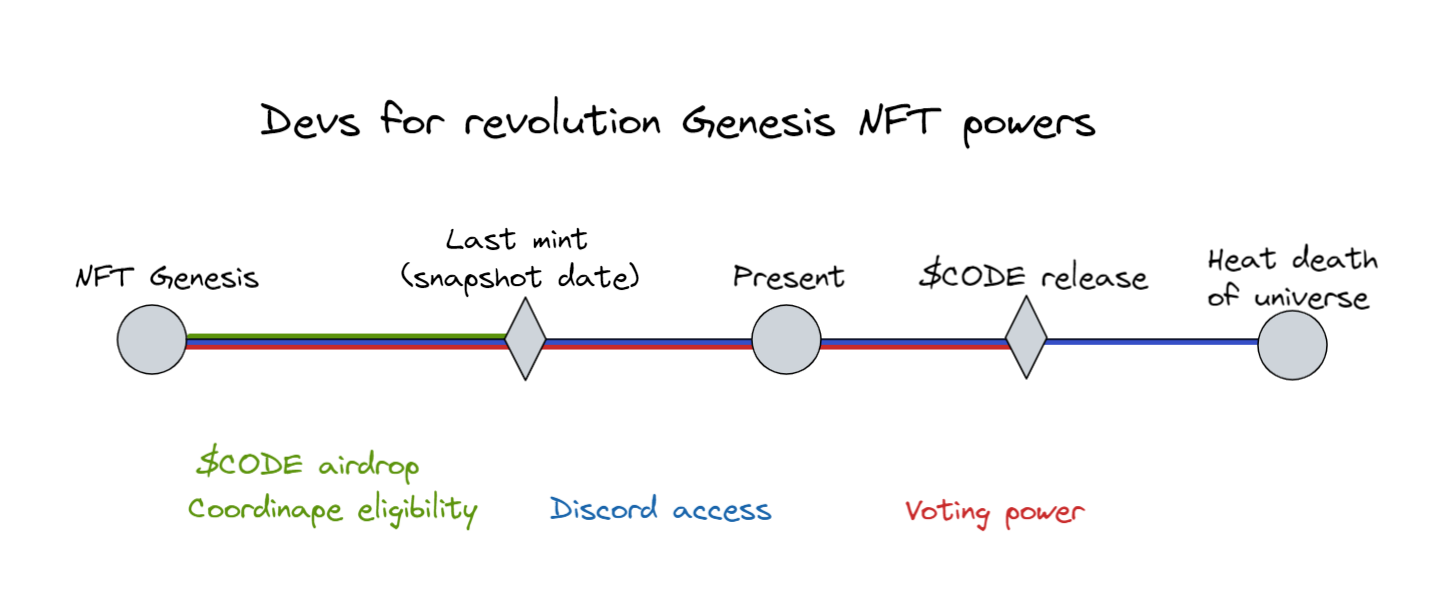
While Algorand leads in structured periodic cycles, other ecosystems are experimenting with different utility models. Some platforms tie governance rights directly to staking mechanisms, where the NFT acts as a key to unlock voting power proportional to the staked assets. Others use "soulbound" tokens that cannot be transferred, ensuring that voting power remains attached to the original contributor's identity. These variations highlight that there is no single standard for governance NFTs; instead, the market is fragmenting into specialized tools designed for specific DAO needs.
To understand how these platforms compare in terms of accessibility and technical implementation, consider the following breakdown of key features across leading governance NFT protocols.
| Platform | Chain | Voting Mechanism | Primary Utility |
|---|---|---|---|
| Pera Wallet | Algorand | Period-based NFT claim | Protocol upgrades & treasury |
| Developer DAO | Ethereum | NFT ownership | Community access & grants |
| Gitcoin | Ethereum | Quadratic voting via NFT | Public goods funding |
Regulatory compliance and legal risks
The regulatory landscape for governance NFTs in 2026 has shifted from speculative enforcement to structured infrastructure design. As decentralized protocols mature, the primary legal challenge is no longer whether these tokens are securities, but how they fit into existing compliance frameworks. The focus has moved toward building on-chain verification layers that satisfy local regulations without destroying the core principle of decentralized sovereignty.
This transition reflects a broader industry realization that regulatory clarity requires technical precision. Governance NFTs are increasingly viewed through the lens of their utility rather than their speculative value. Projects that design their smart contracts with compliance in mind—such as embedding identity verification or jurisdictional restrictions—face fewer legal hurdles. This approach reduces the risk of unintended security classifications, which remain a significant threat for projects with ambiguous tokenomics.
The shift toward infrastructure design means that legal risk is managed through code architecture, not just legal disclaimers. This requires developers to understand the regulatory intent behind each feature.
For DAOs issuing governance NFTs, the burden of proof has shifted. Regulators are less interested in punishing early adopters and more focused on ensuring that current operations do not violate securities laws. This means that governance rights tied to financial benefits must be carefully structured to avoid being classified as investment contracts. The result is a more cautious, yet more sustainable, approach to decentralized governance.
Technical charts and price widgets for related assets show that markets are reacting to these regulatory shifts. Projects that prioritize legal clarity are seeing more stable valuations, as investors prefer the reduced risk profile. This trend is likely to continue as more jurisdictions establish clear guidelines for digital assets.
The key takeaway is that regulatory compliance is now a competitive advantage. Governance NFTs that are designed with legal risk in mind are better positioned for long-term success. This does not mean sacrificing decentralization, but rather finding ways to align decentralized governance with existing legal structures.
The trajectory of governance NFTs
The governance NFT narrative is shifting from speculative collectibles toward functional infrastructure. As the 2021 hype cycle fades, the focus has moved to utility, community credibility, and regulatory compliance. Successful projects in 2026 are those that offer tangible value rather than relying on brand momentum alone.
A significant trend is the integration of governance tokens with real-world assets (RWA). This bridges the gap between decentralized decision-making and traditional finance, allowing token holders to vote on physical collateral or revenue streams. Simultaneously, identity verification is becoming standard to prevent sybil attacks and ensure that voting power reflects genuine human participation rather than bot networks.
This evolution requires robust technical foundations. Governance platforms must handle high transaction volumes while maintaining transparency. The following chart illustrates the broader market context for NFT-related assets, which often correlate with governance protocol activity.
Helpful gear
Use these product recommendations as a starting point, then choose the size, material, and price point that fit how you actually use the gear.

As an Amazon Associate, we may earn from qualifying purchases.
No comments yet. Be the first to share your thoughts!